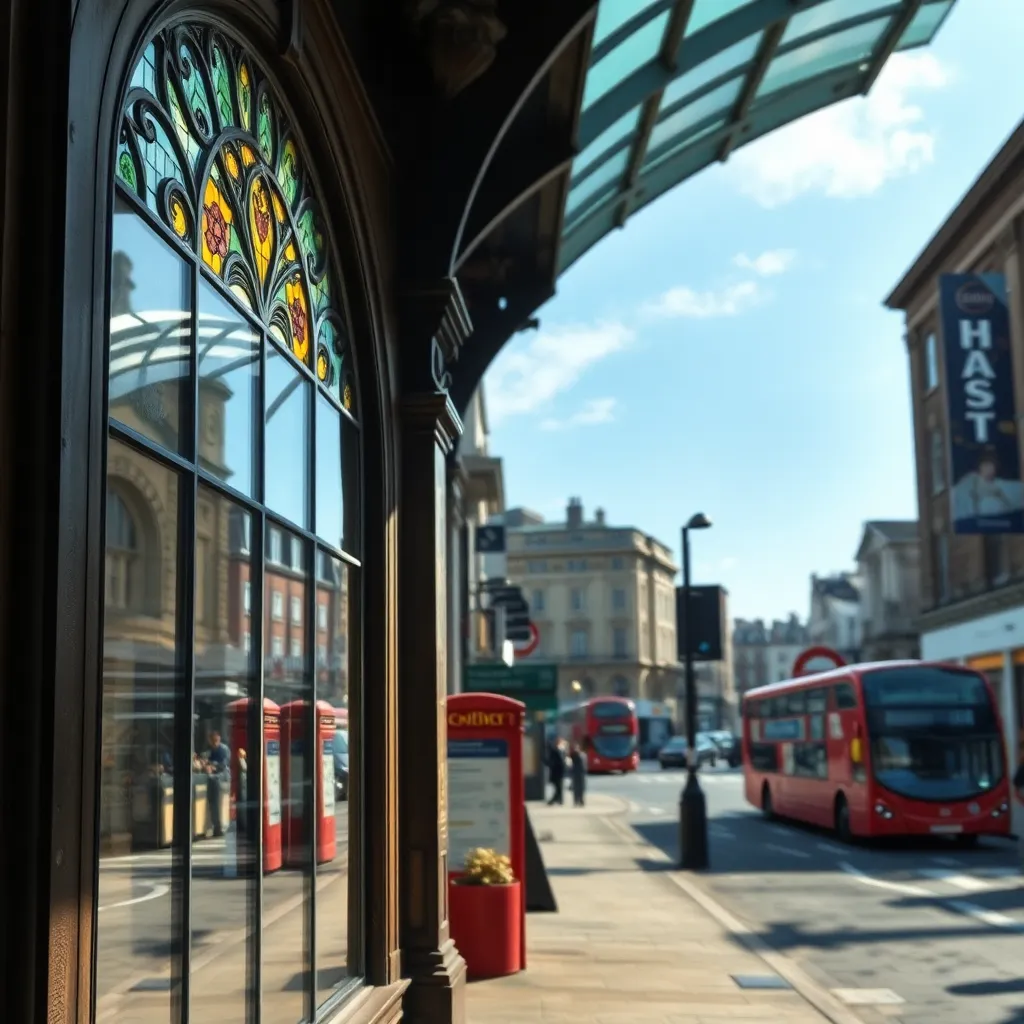
Vintage London: Southwark’s Stained Glass Chronicles
Christ Church Southwark houses a remarkable collection of stained-glass windows that uniquely depict mid-20th century London life rather than traditional religious themes. Designed in the late 1950s by Frederick Cole and Kenneth Bunton, and supplemented by a 1984 set from John Lawson, these windows serve as a vibrant historical record of the local Southwark community. Their primary purpose is to connect the church with its surroundings, offering a snapshot of urban landscapes, daily routines, and societal norms of their respective eras.

A standout example is the window featuring a classic Routemaster double-decker bus, complete with 1950s route numbers and local women carrying shopping, humorously diverging from traditional Magi imagery. Other panels capture significant local landmarks, such as the Bankside Power Station (now Tate Modern) alongside St Paul’s Cathedral and the Faraday Building, symbolizing power and communications. Another window contrasts 18th-century Southwark with the then-modern Nelson Square housing estate, showcasing the area’s evolving architecture.
While offering rich historical insight, some windows reflect societal aspects that have “aged” differently, like the depiction of a secretary in a subservient role to her boss, illustrating mid-century office dynamics. The later 1984 additions continue this local focus, including a distinctive panel featuring a shopping trolley and Sainsbury’s headquarters, highlighting the rise of supermarkets and the transient nature of urban developments, with some depicted buildings like Sampson House now demolished. Other enduring examples include Sea Containers House and the Kirkaldy Testing Works, whose “FACTS NOT OPINIONS” motto is immortalized. Beyond the glass, the church grounds hold further history, including a poignant stone impression marking a WWII cross and a restored 1900 drinking fountain, completing a comprehensive local narrative.
(Source: https://londonist.com/london/history/a-double-decker-in-stained-glass)